


Imagine walking into your own garden a few months from now…
You step outside with a basket in your hand, and instead of buying tired supermarket food from far-away systems, you harvest living, vibrant, mineral-rich food from soil you helped bring back to life.
Maybe it begins as a small garden for your family. Maybe it becomes a regenerative market garden that feeds neighbours, retreats, cafés, and your local community. Maybe it becomes a beautiful learning place where people gather, remember, plant, harvest, breathe, and grow their power back together.
This is the shift we are here for: moving away from food systems dependent on synthetic fertilisers, depleted soils, long transport chains, chemical thinking, and reductionist “food as commodity” logic toward local compost, aged manures, biomass, cover crops, microbial life, minerals, water wisdom, and food grown with care.
Inspired by the lineages of permaculture, Bill Mollison, regenerative organic farmers, biodynamic growers, syntropic agroforestry, market gardeners, seed keepers, compost makers, and land stewards everywhere, this guide is a small torch for a bigger movement.
This is the New Earth we are growing: living ecosystems, local food systems, healthy bodies, empowered communities, and humans remembering they belong to the web of life.
Note: Brix can be one useful field indicator for plant sap soluble solids, flavour, and crop vitality, but it is not the only measure of nutrition. We use it as one clue within a wider living-soil approach.

From teaching circles to living landscapes
Regeneration becomes real when knowledge leaves the screen and enters hands, soil, gardens, kitchens, and communities. This work is not only theory. It is teaching, observing, planting, composting, designing, harvesting, and helping people remember that abundance can be grown again.
From extraction to Eden: the shift we are making
So many landscapes and bodies have been taught to depend on chemical shortcuts, reductionist thinking, and systems that strip life from the soil while disconnecting us from our own inner terrain. This guide is an invitation to grow back our power: from industrial dependency to thriving ecological Eden oases.
Production-only snapshot
Rows, tunnels, fast crops, and efficient production have their place. Yet without beauty, biodiversity, habitat, deeper soil building, and community, a farm can become all output and not enough soul.
A whole-system living oasis
Our vision bridges productive market gardens with agroforestry, herbs, flowers, trees, chickens, microclimate design, gathering spaces, workshops, and holistic wellbeing so the land becomes both livelihood and medicine.
Want guidance for your individual system?
Text us, share your photos, and let’s see how we can help you.
We support people who want to design or regenerate a small farm, edible landscape, food forest, retreat garden, syntropic row system, or holistic regenerative business model.
Small-scale farm designMediterranean crop planningFood forests & agroforestrySyntropic bedsChickens in the systemWorkshops & online educationDetox & terrain reset education
Our deeper passion is whole-systems regeneration. The body’s microbiome and terrain mirror the Earth’s soil food web and outer terrain. A holistic life, brain, body, energy, and land all go together.
Educational note: our detox and terrain-reset support is educational and lifestyle-oriented, not a substitute for medical diagnosis or treatment.
Beautiful example gardens & practical inspiration
Below are moods and design seeds for a public page. Replace these blocks with your own photos when ready.
A hybrid Mediterranean regenerative income model
One of the most powerful pathways for Portugal and similar climates is not choosing between agroforestry and intensive market gardening, but weaving them together.
1. Intensive market garden core
Use permanent beds for salad, herbs, roots, flowers, bunching greens, nursery crops, and fast rotations that create weekly cash flow.
2. Food forest edges
Interlace olives, figs, pomegranates, mulberries, grapes, nitrogen fixers, Mediterranean herbs, pollinator habitat, and biomass species.
3. Chickens in the system
Use chickens in orchard or food forest zones, or mobile systems, to cycle nutrients, reduce pests, and add eggs and educational value while keeping fresh produce hygiene strong.
4. Experiences + education
Add workshops, tours, retreat meals, online classes, and consultations so knowledge becomes part of the income stack, not just produce.
1. The essence: grow better, cycle faster, sell closer
The revolutionary small farm is not a giant field. It is a living engine: permanent beds, compost-rich soil, rapid succession, beautiful harvesting, loyal local customers, and multiple income streams buzzing together like a garden hive.
Permanent beds, hand tools, broadforks, seedling trays, drip lines, carts, and smart crop planning can outperform big machinery thinking on tiny acreage.
Salad mix, herbs, radish, microgreens, spring onions, flowers, and seedlings can create weekly cash flow instead of one annual harvest.
CSA boxes, restaurants, retreats, farm stands, WhatsApp preorders, and workshops keep value on the farm.
Compost, mulch, cover crops, living roots, fungi, worms, and minimum disturbance reduce irrigation stress and increase resilience.
Model inspirations from regenerative small-farm pioneers
Fortier-style organic market garden
Permanent beds, hand-scale efficiency, succession planting, crop planning, low infrastructure, and direct marketing.
Permanent bedsDirect salesEfficient toolsNo-dig / Charles Dowding lineage
Compost-rich beds, minimal disturbance, covered soil, reduced weeding, and calmer production.
Compost mulchLess weedsSoil lifeSinging Frogs-style soil-first farm
Biodiversity, compost, no-till principles, and biologically alive soil supporting farm economics.
BiodiversityWater resilienceSoil-centeredKiss the Ground / regenerative lens
Keep soil covered, minimize disturbance, increase biodiversity, and bring carbon and life back into the land.
RegenerationSoil carbonEducationRegenerative gardening book library: modern science, ancient roots, practical magic
Before we build beds, we build eyes. These books train the gardener to see soil as a living village, edges as abundance portals, and the farm as a choreography of water, roots, fungi, sunlight, and human care.
Gaia’s Garden — Toby Hemenway
Best for home-scale permaculture, guild thinking, useful edges, and the shift from “garden as object” to “garden as ecosystem.” Read this for pattern language and beautiful household-scale design.
Permaculture 101GuildsHome-scaleEdible Forest Gardens — Dave Jacke & Eric Toensmeier
The deeper forest-garden encyclopedia: ecology, succession, layers, beneficial relationships, design process, case studies, and plant matrices. Best for food forest designers who want roots under their ideas.
Food forestsEcologyDesign depthDirt to Soil — Gabe Brown
A clear regenerative agriculture compass: reduce disturbance, keep soil covered, keep living roots, increase diversity, and integrate animals where appropriate. Use it as the soil-health backbone for every design.
Soil principlesRegenerationWhole farmNo Dig Organic Home & Garden / No Dig — Charles Dowding
For reliable annual vegetable beds: compost on top, minimal disturbance, calmer weeds, faster planting, and simple systems that ordinary humans can actually maintain.
No-digCompostEasy winsFor the Love of Soil — Nicole Masters
A practical bridge between biology, minerals, observation, farm economics, and ecosystem health. Read it when you want to diagnose soil like a living patient, not punish it like a broken machine.
Soil healthObservationFarm resilienceThe Regenerative Grower’s Guide to Garden Amendments — Nigel Palmer
Perfect for the DIY alchemist: leaf mould, weeds, eggshells, bones, minerals, ferments, extracts, and low-cost inputs made from local materials. This belongs beside the compost bay.
DIY inputsFermentsLocal materialsThe One-Straw Revolution — Masanobu Fukuoka
The poetic ancestor of radical simplicity. It asks: what can we stop doing so nature can start doing? Best read slowly, with bare feet, near a tree.
Natural farmingLess interferenceWisdomKorean Natural Farming + JADAM
For microbial inputs, indigenous microorganisms, fermented plant juices, and ultra-low-cost farming ideas. Treat these as powerful tools: start small, observe, dilute carefully, and respect your local ecology.
IMOsMicrobesLow-costFarming While Black — Leah Penniman
A reminder that regeneration is not only soil technique. It is food sovereignty, dignity, ancestral skill, community repair, and the healing of broken food systems.
Food justiceCommunityAncestral wisdomModern-ancient gardening hacks: the highest-impact moves first
These are not tricks. They are small doors into big systems. Do them consistently and the garden begins to behave less like a hungry baby and more like a well-fed forest creature.
| Hack | How to do it simply | Why it works | Benjy-style field note |
|---|---|---|---|
| Never leave soil naked | Use living cover, compost, straw, leaves, woodchip paths, or chop-and-drop. | Covered soil stays cooler, holds moisture, feeds microbes, and protects structure. | Bare soil is a stressed nervous system. Give it a blanket. |
| Turn paths into fertility factories | Dig shallow path trenches, fill with woody matter, charcoal, aged manure, old soil, leaves, and chips. | Paths catch water, grow fungi, reduce weeds, and slowly feed adjacent bed edges. | The path is not wasted space. It is the garden’s hidden stomach. |
| Charge charcoal or biochar first | Soak charcoal/biochar in compost tea, diluted urine, seaweed, manure tea, worm juice, or IMO/JMS before adding. | Biochar holds water and nutrients better when inoculated and pre-loaded. | Empty charcoal is a hotel with no guests. Charge it, then invite the microbes. |
| Use manure wisely | Compost cow, horse, and chicken manure before food beds. Use chicken manure sparingly because it is concentrated. | Composting reduces burn risk, pathogen risk, weed seeds, and nutrient overload. | Manure is dragon fire: compost it into hearth-warmth before feeding vegetables. |
| Bring forest biology gently | Collect a tiny amount of healthy leaf mould or forest soil where legal and ethical, then multiply it in compost/IMO/JMS. | Local decomposer communities help kick-start fungal and bacterial diversity. | Do not mine the forest. Ask for a teaspoon of its memory and grow it at home. |
| Mycorrhiza at the root zone | Apply mycorrhizal inoculant directly to seedling roots, tree roots, or planting holes, not randomly on dry surfaces. | Many fungi need root contact to establish beneficial relationships. | Fungi want introductions, not confetti. |
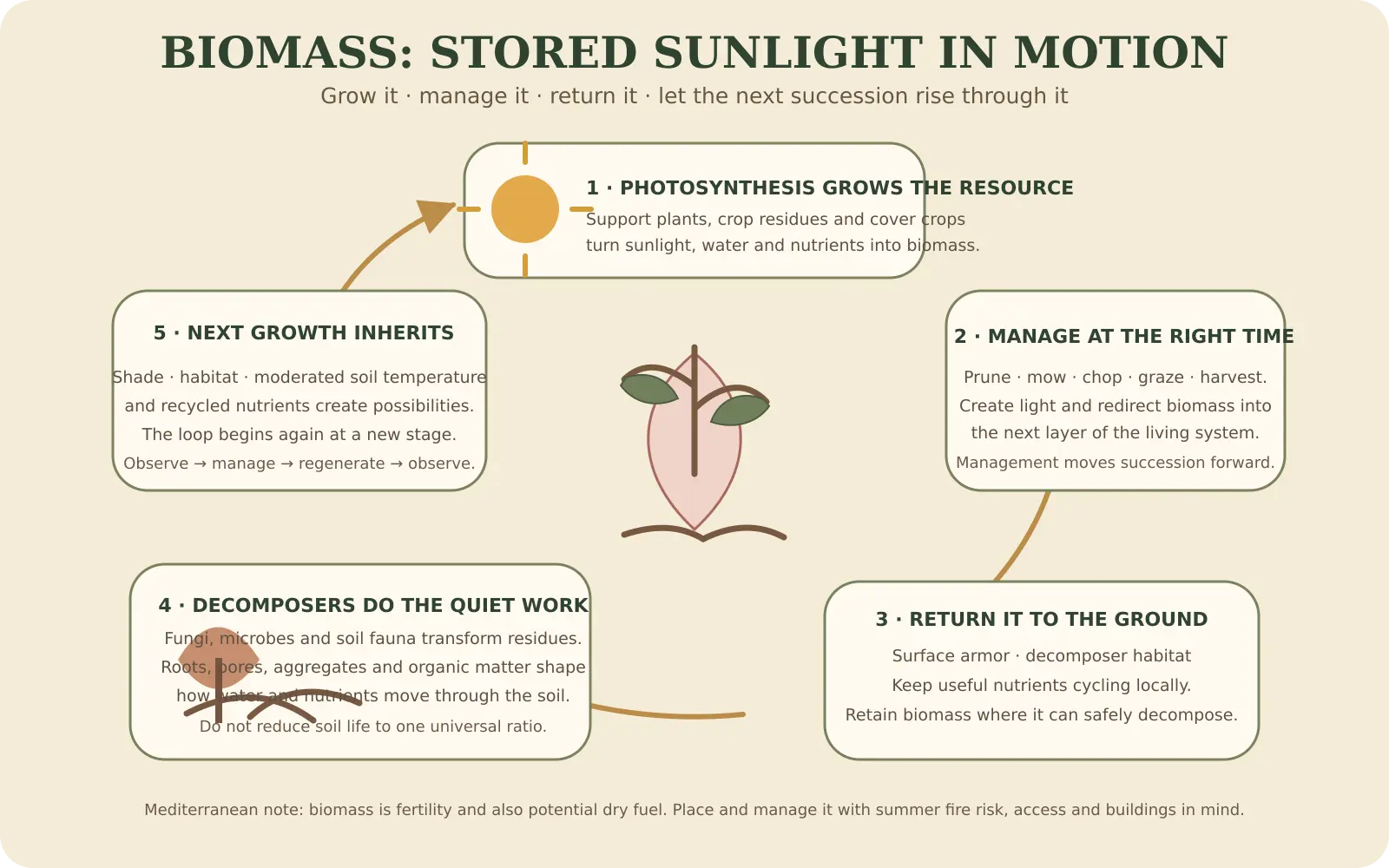
| Grow biomass on purpose | Plant comfrey, grasses, fava, vetch, cowpea, sunn hemp, Mexican sunflower, pigeon pea where climate allows. | Biomass is future mulch, carbon, roots, insect habitat, and fertility. | Every chop-and-drop is a small thunderstorm of minerals returning home. |
| Create microclimates before buying inputs | Use windbreaks, shade cloth, trellises, trees, mulch, and water basins. | Plants need less rescue when heat, wind, and evaporation are softened. | A garden with shelter becomes brave. |
| Use edges as production amplifiers | Plant herbs, flowers, berries, nitrogen fixers, and perennials along path/bed/tree edges. | Edges gather light, airflow, water, pollinators, human attention, and harvest diversity. | The edge is where the garden sings loudest. |
3. A practical 1/4-acre Mediterranean layout
A quarter acre is roughly 1,000 m². Do not fill all of it with vegetables. A profitable microfarm needs growing space, nursery, wash/pack, compost, paths, water, shade, storage, and beauty.
| Zone | Suggested space | Purpose | Mediterranean notes |
|---|---|---|---|
| Permanent annual beds | 400-600 m² | High-value vegetables, herbs, flowers | 75-100 cm beds, 35-50 cm paths, drip lines, mulch, summer shade cloth. |
| Propagation nursery | 50-120 m² | Seedlings for the farm plus sales | Shade net, insect net, reliable watering, wind protection. |
| Protected tunnel / greenhouse | 80-200 m² | Tomatoes, cucumbers, basil, winter greens, seedlings | Ventilation is critical. Use protected cultivation to reduce stress. |
| Wash/pack/cool area | 20-60 m² | Clean harvests and quality control | Shade, washable surfaces, crates, scale, labels, fast cooling. |
| Compost + biomass | 80-150 m² | Compost, worm system, leaf mould, mulch storage | Keep manure aged and safe. Build fertility close to the farm heart. |
| Perennial edges | 100-250 m² | Fruit, herbs, flowers, pollinators, windbreaks | Rosemary, lavender, thyme, sage, fig, pomegranate, olive, almond, carob, grape, artichoke. |
4. Crop choices for high nutrition, high value, and Mediterranean resilience
| Crop group | Best crops | Why it works | How to sell |
|---|---|---|---|
| Quick-turn greens | Rocket, lettuce mix, mizuna, mustard, baby kale, spinach in cool season | Fast cash flow, repeat harvests, restaurant demand | Premium salad bags, chef mixes, CSA greens add-on |
| Herbs | Basil, coriander, parsley, dill, mint, oregano, thyme, rosemary, sage | High value per m², fragrant, small harvest volume | Bunches, living pots, dried herbs, tea blends, infused salts |
| Microgreens | Sunflower, pea shoots, radish, broccoli, basil, coriander | Fast cycles, indoor/shade production, premium chefs | Restaurants, retreats, health cafés, subscription trays |
| Summer fruiting crops | Cherry tomato, cucumber, pepper, eggplant, zucchini, okra | Strong summer demand, good with trellising and shade | Chef boxes, tomato tasting boxes, sauce days, farm stand |
| Roots + bunching | Radish, baby beet, carrot, turnip, spring onion | Beautiful bunches, quick bed turns, CSA color | Farmers market bundles, salad box upgrades |
| Flowers + edible flowers | Calendula, nasturtium, borage, cosmos, zinnia, marigold, chamomile | Pollinator support and high perceived value | Wedding bunches, edible flower boxes, herbal products |
| Perennial Mediterranean crops | Olive, fig, pomegranate, grape, almond, carob, citrus where irrigated, caper, artichoke | Resilience, story-rich products, lower annual planting | Olive oil, dried figs, pomegranate syrup, herb-fruit baskets, tours |
| Biomass + soil builders | Fava bean, vetch, clover, cowpea, sunn hemp, Mexican sunflower, comfrey, grasses | Mulch, nitrogen, roots, fungi, chop-and-drop | Internal value: fertility, water retention, weed control |
5. How to build productive beds
No-dig bed build
- Mow or cut weeds low.
- Water the soil deeply if dry.
- Lay plain cardboard over weedy ground, overlapping edges.
- Add 10-15 cm finished compost or aged compost/manure blend.
- Shape beds 75-100 cm wide so nobody steps on them.
- Install drip lines immediately.
- Plant transplants into compost; sow larger seeds directly.
- Keep paths mulched with woodchip, straw, leaves, or living cover.
Compacted soil rescue
- Broadfork once, without turning soil.
- Add compost, worm castings, and a light mineral blend if soil tests justify it.
- Grow deep-rooted daikon, fava, chicory, or clover off-season.
- Keep soil covered all year.
- Avoid repeated rotavating. It creates a fluffy sugar-rush, then soil structure crashes.
Fertility rhythm
- Compost: thin layer between crop turns.
- Worm castings: seedling holes and high-value greens.
- Aged manure: composted first, used carefully.
- Basalt/rock dust: small annual doses where useful.
- Seaweed extract: stress tonic and trace elements.
- Cover crops: fava/vetch/clover cool season; cowpea/sunn hemp warm season.
Benjy’s Abundant Edge Signature: hügel-pathways, living borders, and fungal food-forest seams
This is the Regenerative Eden field spell: stop treating paths and edges as dead lines. Turn them into buried fertility rivers. The beds grow food; the edges grow the future.
The core idea
Between beds, along food forest edges, beside tree guilds, and around garden borders, dig a shallow trench or sunken pathway. Fill it with slow food for fungi and worms: logs, sticks, prunings, woodchip, straw, leaves, charcoal, a little compost, old living soil, and well-composted manure.
Ancient European hugel wisdom, path version
Classic hügelkultur uses wood beneath raised mounds. The Abundant Edge adapts the same old-world woody-sponge logic into paths and borders, especially useful in dry Mediterranean gardens where every path can become a sponge, mulch bank, and fungal corridor.
Abundant Edge build recipe
| Layer | Material | Approximate amount | Purpose |
|---|---|---|---|
| 1. Basin | Dig pathway/edge 15-30 cm deep, slightly sloped to catch water safely. | Only where water will not flood buildings or sensitive roots. | Creates a moisture pocket and compost-in-place channel. |
| 2. Wood bones | Old logs, sticks, branches, pruning waste, rotten wood. | Fill the bottom loosely. | Long-term carbon, fungal habitat, water sponge. |
| 3. Charcoal memory | Crushed charcoal or biochar, ideally pre-charged. | A dusting to 5% of the fill, not a black desert. | Microbe habitat, nutrient holding, water buffering. |
| 4. Nitrogen warmth | Composted cow/horse manure; very small amount composted chicken manure. | Thin layers, mixed with carbon. | Balances woody carbon and feeds decomposition. |
| 5. Living inoculum | Leaf mould, old garden soil, compost, worm castings, IMO/JMS, mycorrhizal fungi near roots. | Small amounts, spread through the upper layers. | Starts the underground village. |
| 6. Soft cover | Old soil, compost, straw, leaves, woodchips. | Cover until no manure/food scraps are exposed. | Protects moisture, prevents smell, keeps feet clean. |
| 7. Edge planting | Comfrey, yarrow, calendula, oregano, thyme, clover, strawberries, nasturtium, pollinator flowers, biomass plants. | Plant along the shoulders, not in the walking lane. | Turns the seam into food, medicine, mulch, and insects. |
Where to use it
- Between annual beds where paths are too lifeless.
- Along the sunny side of food forests.
- Around olive, fig, citrus, pomegranate, grape, and herb guilds.
- At the base of future trellises and climbing plant tunnels.
- On contour where water can soak safely.
Where to be careful
- Do not bury fresh manure near crops that will be harvested soon.
- Avoid walnut, treated wood, painted wood, diseased material, and synthetic-contaminated chip.
- Keep woody, high-carbon material mostly in paths/edges or deeper layers, not mixed heavily into seedling root zones.
- Watch rodents: cover well and avoid exposed food scraps.
- In fire-risk landscapes, keep dry surface mulch managed and irrigated around buildings.
Fast version for busy gardens
- Scrape path 10-15 cm lower than bed.
- Add sticks, leaves, chip, a little compost/manure, old soil.
- Water deeply with diluted compost tea/IMO/JMS.
- Top with woodchip or straw.
- Plant the path edges with herbs and flowers.
6. Mediterranean water strategy: every drop gets a job
Soil sponge first
Compost, cover crops, mulch, living roots, and fungal structure make irrigation go further.
Drip, not drama
Use drip lines, timers, pressure regulation, filters, and morning irrigation. Watch beds, not assumptions.
Shade intelligently
Use summer shade cloth, trellises, tree edges, and windbreaks to reduce evapotranspiration.
Harvest water in the landscape
Swales, basins, contour rows, mulch pits, and agroforestry edges slow water and feed roots.
7. Income streams that fit a tiny regenerative farm
| Income stream | Why it works | First experiment |
|---|---|---|
| Founder harvest boxes | Pre-sells demand and builds loyal customers | 10 weekly boxes with salad, herbs, roots, flowers |
| Restaurants and retreat kitchens | Value freshness, story, reliability, beautiful herbs | Visit 5 chefs with a sample box and weekly availability list |
| Seedlings and living herbs | Low transport weight and strong spring demand | 50 basil, parsley, calendula, tomato seedlings |
| Workshops and tours | Turns knowledge into income and community | Run a 2-hour “Start Your Regenerative Garden” workshop |
| Consults and design calls | Low material cost and high knowledge value | Offer photo/video-based online garden guidance |
| Herbal products | Uses surplus, flowers, drying, and story | Tea blend, herb salt, calendula oil, dried oregano |
8. Mediterranean seasonal rhythm
Autumn
Plant cool-season greens, fava, peas, brassicas, garlic, onions, herbs, and cover crops. Build compost and mulch before rains.
Winter
Harvest greens, plan crop rotations, repair beds, prune trees, sow early trays, and protect sensitive crops.
Spring
Succession sow, transplant tomatoes/cucumbers/basil, sell seedlings, plant flowers, and prepare irrigation before heat.
Summer
Shift to shade, mulch, drip discipline, early harvests, trellising, okra, basil, fruiting crops, and drought-resilient perennials.
9. 12-week launch plan
Weeks 1-2: Map and market
- Draw site map: sun, shade, water, wind, access, frost.
- Interview 10 possible buyers: chefs, retreat owners, cafés, neighbours.
- Choose 6 starter crops, not 60.
Weeks 3-4: Build the first system
- Create 6-10 permanent beds.
- Install drip irrigation and mulch paths.
- Start nursery trays every week.
Weeks 5-6: Brand and pre-sell
- Create a simple weekly harvest list.
- Launch 10-20 founder boxes.
- Make one farm story post per week.
Weeks 7-8: Harvest quality
- Harvest early morning.
- Wash, cool, pack beautifully.
- Ask customers what they loved and what they did not use.
Weeks 9-10: Improve crop mix
- Drop low-profit headaches.
- Double down on crops people reorder.
- Add herbs, edible flowers, or microgreens.
Weeks 11-12: Add one income layer
- Run a workshop or farm tour.
- Offer seedlings or a consult.
- Create a subscription renewal.
Short inspiration + education to weave through every chapter
Use these as tiny golden seeds inside the page, captions, reels, workshop notes, and client proposals.
| Chapter / area | Beautiful short guidance | Practical teaching seed |
|---|---|---|
| Invitation | Imagine a garden that feeds your body, your neighbours, your bank account, and the soil beings beneath your feet. | Make the opening emotional: abundant harvest, nutrient density, local resources, less dependence on chemical supermarket systems. |
| Vision | Regeneration begins when we stop asking the land to perform and start asking what life wants to become here. | Observe sun, wind, water, access, existing trees, wild plants, and soil before designing. |
| Hybrid model | Annual beds are the quick heartbeat. Perennial edges are the long breath. | Combine fast-income crops with slower fruit/herb/tree systems for resilience. |
| Book library | Every great garden is a library with roots, and every great book is a seed with pages. | Choose one book for design, one for soil, one for business, one for spirit. |
| Soil hacks | The most advanced technology in the garden is still the living soil food web. | Prioritize cover, living roots, diversity, compost, mulch, and water infiltration before expensive inputs. |
| Layout | Design for the tired day, not the inspired day. | Short paths, nearby tools, easy wash station, clear crop blocks, and irrigation that works without daily heroics. |
| Crops | Grow what your climate loves, your customers use, and your hands can harvest joyfully. | Start with 6-10 reliable crops before adding plant-chaos confetti. |
| Beds | A permanent bed is a promise: “No feet here. Only roots, worms, water, and care.” | Keep beds narrow enough to reach from both sides; never walk on them. |
| Abundant Edge | Edges are the garden’s secret pockets: moisture, fungi, flowers, lizards, bees, and future fertility. | Convert paths and borders into carbon-rich, mulched, planted fertility seams. |
| Water | In Mediterranean summers, water must travel like wisdom: slow, shaded, and never wasted. | Use drip, mulch, shade, compost, organic matter, wind protection, and contour thinking. |
| Business | Sell freshness, story, reliability, beauty, and belonging, not just vegetables. | Create weekly harvest lists, founder boxes, workshop offers, and simple WhatsApp ordering. |
| Calendar | The garden is a seasonal drum. Plant with the rhythm, not against it. | Cool-season greens and legumes in autumn/winter; heat lovers, shade, mulch, and drought resilience in summer. |
| Launch plan | Begin small enough to finish, beautiful enough to share, and useful enough to sell. | Build 6-10 beds, test buyers, track harvests, then expand from evidence. |
10. Eight-point checklist for a small regenerative market farm
Sources and inspiration list to keep in the final page
- Jean-Martin Fortier / The Market Gardener approach
- Charles Dowding no-dig gardening: charlesdowding.co.uk
- Charles Dowding & Stephanie Hafferty, No Dig Organic Home & Garden
- Toby Hemenway, Gaia’s Garden, home-scale permaculture
- Dave Jacke & Eric Toensmeier, Edible Forest Gardens, Chelsea Green
- Gabe Brown, Dirt to Soil, and the soil health principles: minimize disturbance, cover soil, living roots, diversity, and animal integration where appropriate
- Nicole Masters, For the Love of Soil, Integrity Soils
- Nigel Palmer, The Regenerative Grower’s Guide to Garden Amendments
- Masanobu Fukuoka, The One-Straw Revolution
- Korean Natural Farming / indigenous microorganisms: University of Hawai‘i CTAHR, ECHO Community
- JADAM Organic Farming by Youngsang Cho: ultra-low-cost organic farming and microbial inputs
- Hügelkultur and woody bed inspiration: old European log-and-branch bed traditions, permaculture practice, and modern garden adaptations
- Biochar soil health, water retention, and nutrient retention research from Wageningen, Oregon State University Extension, and recent soil science reviews
- Safe manure use guidance: UNH Extension, Oregon State University Extension, Penn State Extension
- Organic matter and water-holding capacity guidance: Utah State University Extension
- FiBL Mediterranean farming systems overview
- Organic Farm Knowledge: protected cultivation in Mediterranean systems
- FAO greenhouse vegetable crop guidance
- Organic Farming Research Foundation: cover cropping resources
- Kiss the Ground
- USDA Community Supported Agriculture overview
- NCAT/ATTRA market gardening start-up guide
For land design, food forests, regenerative gardens, workshops, and holistic detox education: WhatsApp +351 920 067 347 · regenerativeeden@gmail.com